My introduction to Marrakech began shortly after landing just after 4 in the afternoon. After making my way through customs/passport control, I was picked up by a driver around 5 and taken toward the Souks of Old Town Medina, where I would be staying for the week.
I had heard about the souks before arriving—described as a dense, historic marketplace hidden within the Old Medina, where narrow passageways twist through centuries of trade, craftsmanship, and daily life. People spoke of them as both fascinating and disorienting, a place where navigation itself becomes part of the experience. Still, hearing about it and actually arriving are two very different things.
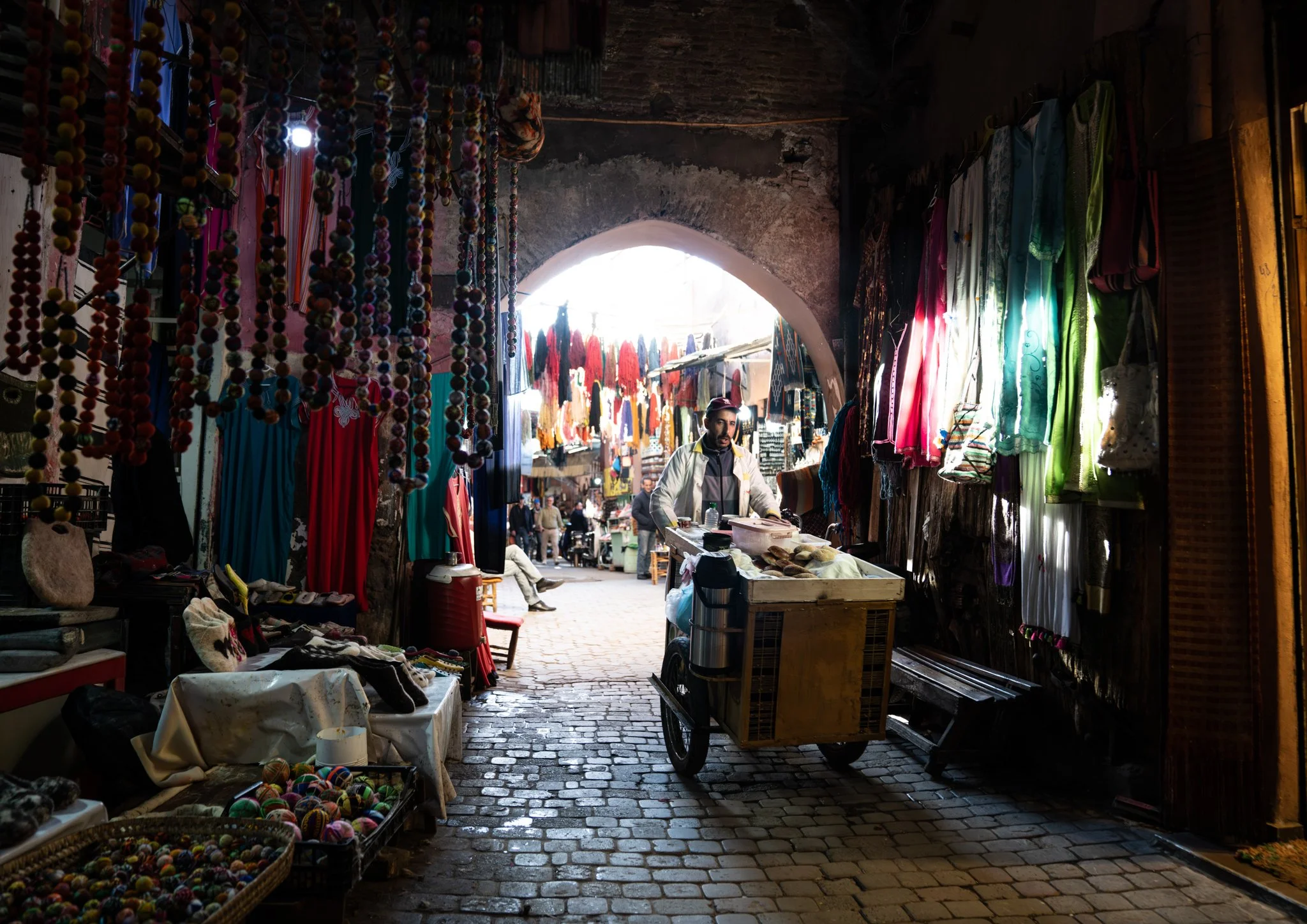
As we approached the historic district, it quickly became apparent that this was unlike anywhere I had ever been. The light itself seemed different as we entered the edge of the Medina—warmer, dustier, softened by centuries of movement through stone and air. The area was full of back alleyways, tunnels, and brick/cobblestone roads. Many of the passageways were so narrow that cars couldn't pass through them. My driver dropped me off at the edge of one of these alleyways, and from there I was on my own.
It was only at that moment, standing at the entrance of the souks, that I truly understood what I was stepping into. The souks revealed themselves as a maze in the most literal sense. Narrow passageways stretched in every direction, folding into each other without any clear pattern or visible end. It didn’t feel like a market you walk through so much as a system you enter, where direction becomes abstract almost immediately. There was no sense of scale, no clear map to follow, just layers of corridors that seemed to dissolve into one another the deeper you went.
Almost immediately, I felt lost.
Every direction I turned revealed another narrow alley lined with old wooden doors, dim shopfronts, and vendors whose voices echoed strangely off the stone walls. The air carried layers of scent(spices, dust, leather, metal) and something faintly sweet from nearby stalls, blending into something I couldn’t quite place. People filled the streets, motorbikes whizzed past with sudden bursts of sound and wind, and I struggled to make sense of where I was supposed to go. I am usually someone who plans ahead and likes to know exactly where I'm headed, but this was one situation where all of that preparation seemed useless. There were simply too many alleys and too many turns.
Moving deeper into these tunnels and passageways left a lasting impression that was difficult to articulate in the moment. There was a sense of deep historical mysteriousness to the place, something that felt like it could only be understood through time, depth, and repeated presence. It wasn’t just the physical layout, but the feeling of moving through layers of history that had been built, worn, and reshaped over centuries. The stone underfoot felt uneven and timeworn, as if it had been shaped more by footsteps than by intention. The air itself carried a subtle mustiness, thick with age and constant human presence layered over generations.
Everything about the environment was new to me. I had traveled internationally before, but this felt different. The density of life, the way space seemed to shift and compress around every turn, the constant echo of movement and sound—it was unlike anything I had experienced.
I spent a week in the Old Medina of Marrakech, and if I'm being honest, it was overwhelming from beginning to end.
The Medina is the historic heart of Marrakech, dating back nearly a thousand years. Founded in the 11th century, it became an important center of trade and culture, and many of its narrow streets and winding alleyways still reflect that history today.
Walking through the Medina felt like stepping into another world. The souks seemed endless, a shifting labyrinth of shadowed passageways where the light bends differently, filled with merchants selling spices, textiles, leather goods, lanterns, and handcrafted items. It often felt less like walking through a market and more like being pulled through a living maze that changes each time you turn your head. Around every corner there was another shop, another alleyway, and another attempt to draw visitors inside. The crowds, sounds, and activity never seemed to stop.
At the center of it all is Jemaa el-Fnaa, the city's famous square and one of the most recognizable gathering places in Morocco. During the day and well into the evening, the square is packed with performers, food vendors, musicians, and crowds of locals and tourists. It is impossible to walk through without being drawn into the energy of the place.
Among the most memorable sights were the snake charmers and the monkeys that many visitors stop to photograph. Seeing them in person was certainly a unique experience and something I had previously associated only with travel documentaries and postcards. Whether fascinating or unsettling, they added to the feeling that Marrakech was unlike anywhere I had ever visited.
What struck me most was that the Medina is not simply a historic site. It is a living, working community where centuries-old traditions exist alongside modern life. Motorbikes weave through ancient alleyways, merchants continue family trades passed down through generations, and daily life unfolds amid buildings and streets that have stood for hundreds of years.
The week was not relaxing. The constant movement, noise, and sensory overload could be exhausting at times. Yet that intensity is exactly what made the experience unforgettable. Marrakech challenged me, pushed me outside my comfort zone, and gave me a deeper appreciation for a culture and history very different from my own.
Looking back, I may not have always been comfortable, but I was never bored. The Medina of Marrakech is a place that leaves a lasting impression long after you leave its walls behind.